
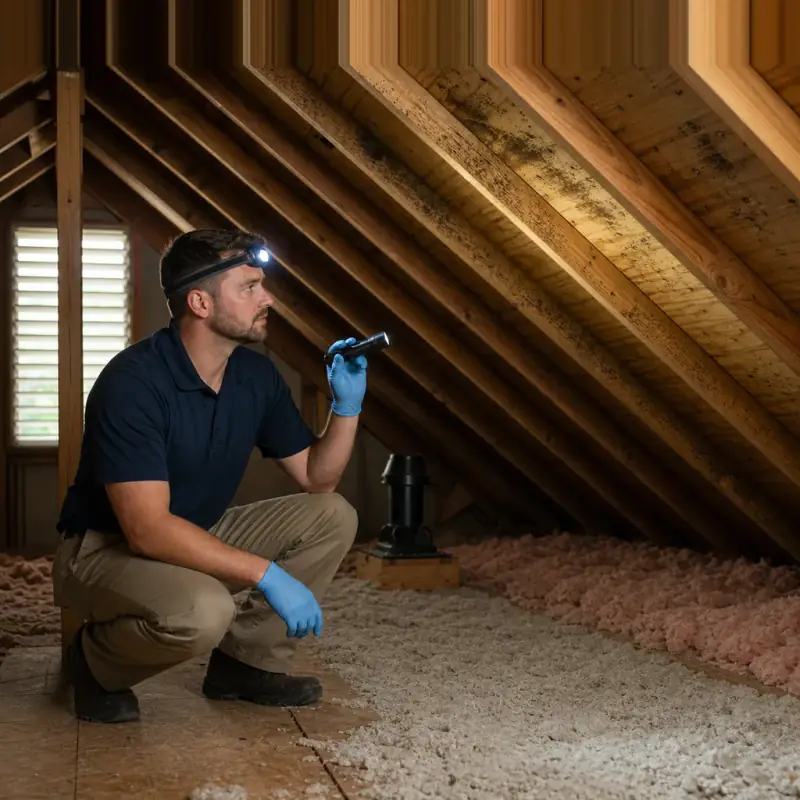
Attic Mold Remediation Services Attic Mold? Let's Get to the Source.
Attic mold remediation from Indiana's mold-only experts. We remove the mold and identify the ventilation or moisture problem behind it, so you know what needs to be addressed to help prevent it from coming back.
Find the source → Remove mold and identify airflow problems → Verify and document
Serving Indiana since 2001 • IICRC & MICRO Certified • Defect-Free Guarantee • A real person answers calls 24/7
Se habla español · Deaf or hard of hearing? ASL interpretation available on request.
 IICRC Certified
 MICRO Certified

What Indiana Homeowners Are Saying
Across Google, Facebook & Housecall Pro
They did an excellent job. Communication was stellar and they were on time for all appointments. They worked quickly and efficiently and took care of a mold problem in our bathroom and attic. I highly recommend them!
⭐⭐⭐⭐⭐ I can’t say enough great things about Aaron at Indiana Mold Remediation! He was incredibly caring, patient, attentive, and knowledgeable. It’s rare to find a company that genuinely puts its customers first, but they truly do! You can…
Amazing company! Excellent employees, and great communication. Would recommend them to anyone!
He put my mind at ease and truly knows what he's doing a mold restoration. His crew was very professional and explained their process and did post follow up to explain the last phase of treatment. Highly recommend
They were on time and communicated with us during the process. They were the best priced as well. I am happy with the service. There was a spot right outside of the room they worked in where some of the stuff they sprayed got on our floor…
IMR were very easy to work with and very professional! They quickly assessed the condition of my basement and attic and explained everything they saw. I found them to be honest and forthright, and best of all, the quote was free!
What Causes Mold Growth in Attics?
Attic mold is rarely random. It usually traces back to one of a few moisture and airflow problems: a roof leak, inadequate or blocked attic ventilation, compressed or missing insulation, or a bathroom exhaust fan that vents into the attic instead of outdoors. That's why removing the mold without addressing the cause is a temporary fix at best. As mold-only experts serving Indiana since 2001, we address the mold and identify the underlying cause.
Mold needs three things to grow: oxygen, food, and water. Oxygen and food are everywhere in an attic, so the practical way to limit mold is to limit water. These are the common ways moisture builds up.
Inadequate ventilation
An attic needs ventilation so moisture can escape. Hot air rises and leaves through roof vents or powered exhaust fans, and soffit vents under the eaves usually let fresh air in. When those parts are missing or not working, warm, moist air gets trapped, and water condenses on cold surfaces like air ducts and the underside of a cold roof.
Insufficient insulation
Insulation compresses over time and becomes less effective. Sometimes there was never enough, or it has been moved around and left gaps. Either way, too much warm air escaping into the attic causes condensation. This is often the reason for mold that shows up mostly on the north side of the roof, which gets no direct sun and stays cooler than the rest. The fix is usually as simple as adding insulation. For extra protection you can add a vapor barrier between the ceiling and the attic joists, though that gets expensive unless it's done during construction, before the ceiling drywall goes up.
Bathroom exhaust fans
A bathroom fan is supposed to carry hot, steamy air outdoors. If the vent was installed incorrectly or the duct gets damaged, that air and moisture can end up in the attic instead. The result is usually mold near the vent, and if it's left alone it can spread to the rest of the attic.
Moisture from the house below
Even with good ventilation and insulation, too much moisture can still cause mold. Warm air rises, so attic moisture problems usually start with moisture inside the home or the crawl space. There are many possible sources, but faulty humidifiers and pipe leaks are among the more common.
Water leaks
Roof leaks, pipe breaks, and other direct water intrusion can lead to mold in the area that got wet. If the leak isn't corrected, moisture builds up in the air and the mold can spread to the rest of the attic.
Why It Comes Up More Often Now
Attic mold is flagged more often than it used to be. Newer homes are built with lumber that's more porous and takes on moisture more easily than the lumber in older homes. They're also sealed tighter for heating and cooling efficiency, which lets moisture build up. And home inspectors, contractors, and homeowners are simply more aware of mold than they once were.
What to Expect From Attic Mold Remediation
Attic mold is almost always a symptom of a moisture or airflow problem: a roof leak, blocked ventilation, or a bath fan venting into the attic instead of outside. Treat only the mold and it returns. We identify the cause too.
We find the source, not just the mold
We look at the whole picture: roof leaks, attic ventilation, insulation, and bath or kitchen fans that may be dumping warm air that carries moisture into the attic. Knowing the why is what makes the work last.
Remove mold and identify airflow problems
We clean the mold from the decking and framing, treat the surfaces, and identify the ventilation or moisture issue that started it. Insulation usually stays in place, and we remove it only where the insulation itself is moldy. We'll recommend ventilation improvements, but we usually don't do that work ourselves. We work cleanly and keep disruption low.
We verify and document
We check the work before calling it done and give you documentation you can keep. If this came up during a home sale, that record is exactly what buyers, sellers, and agents are looking for.
Not sure what you need? Start with a free 15-minute virtual inspection. Show us what you're seeing, and we'll give you clear next steps.
Did a Home Inspection Flag Attic Mold?
Attic mold is one of the most common things flagged during a home sale. If a report mentioned it, you don't need to panic, you need a clear look and a plan everyone can move forward with.
If you're selling:
- We document the work so you can show buyers it was handled properly
- We move quickly to keep your timeline on track
- We identify the underlying cause and document our remediation work for re-inspection
If you're buying:
- We help you understand what's actually concerning versus cosmetic
- We give you a clear scope and estimate to inform negotiations
- We explain what's reasonable to request or repair
Either way, you get:
- A straight answer about what the attic actually needs
- Documentation you can hand to the other side
- No fear-based pressure to over-remediate
How We Handle Attic Mold
Left alone, attic mold can spread to framing and insulation and is a frequent sticking point during home sales. Our approach is to clean the mold from the wood, treat the surfaces, remove any insulation that is moldy itself, and identify the ventilation or moisture source that needs to be addressed to help keep the attic dry. We'll recommend ventilation improvements, but we usually don't do that work ourselves. It's part of our broader mold remediation work, applied with the specific knowledge an attic needs. We offer service in English and Español, and ASL interpretation is available on request.
See an Attic Treatment
In this video you can see one of our attic treatments, and how a moldy attic looks once it has been cleaned.
Watch: Attic Mold Cleaning in IndianaOpens on YouTube in a new tab
Our Defect-Free Guarantee
We do remediation the right way the first time. That means clear scopes, appropriate containment when needed, professional remediation standards, and verification steps before we call it done.
And if the job's not right, we will fix it to your satisfaction, or you don't pay. That is our Defect-Free Guarantee.
Let's get your attic handled.
Send us a few photos or book a free virtual inspection. We'll tell you what's really going on up there, and what needs to be addressed to help keep it from coming back. No pressure, no obligation.